Pilates - The Value of Moving Well
The benefits of Pilates and its place in a lifelong approach to strength, movement and longevity.
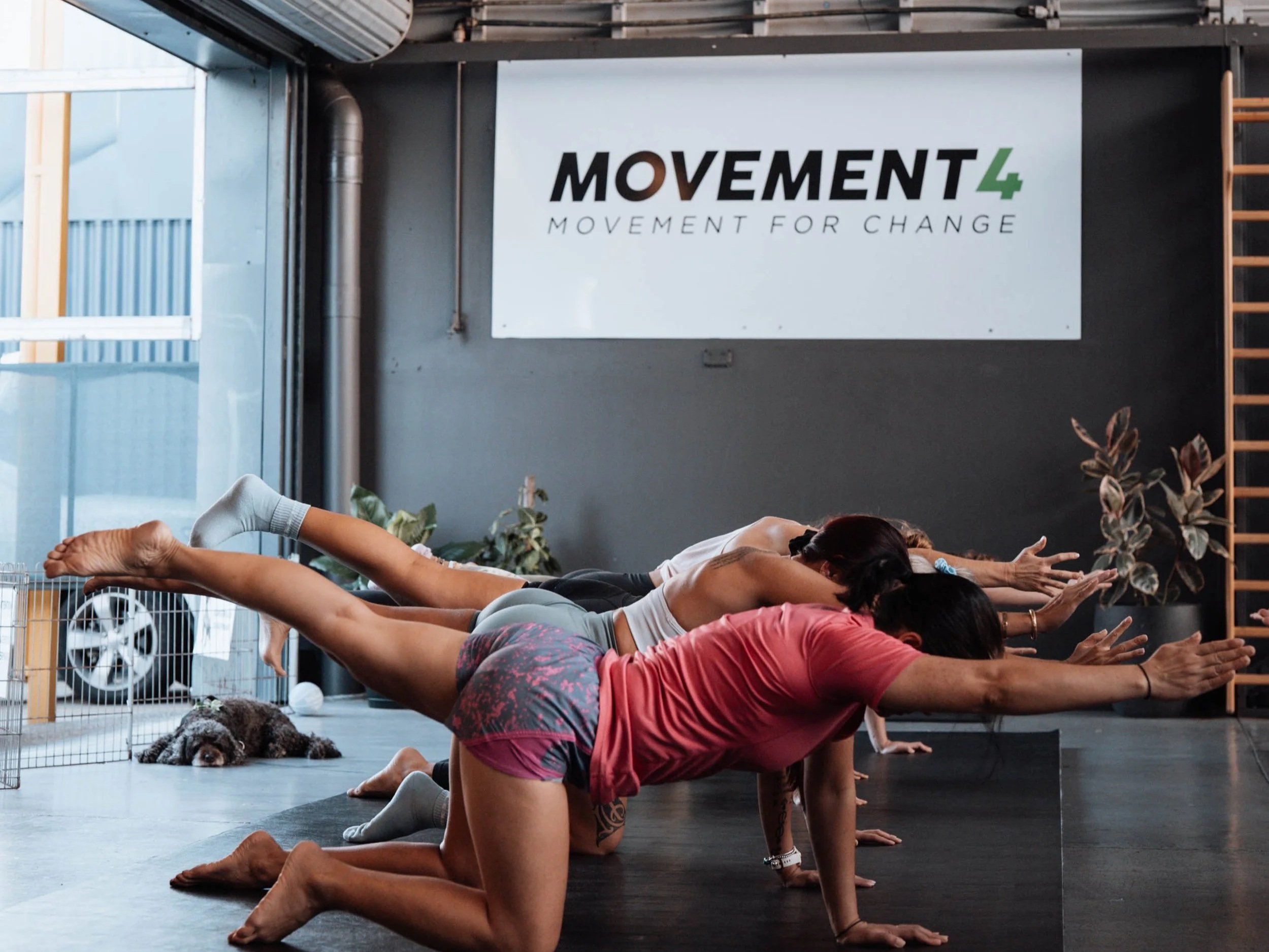
I have recently returned to teaching a weekly Pilates mat class at Movement 4, and this has prompted me to reflect on what I love most about the practice, why I continue to value it and what I hope others will gain from experiencing it.
Pilates has been part of my life for many years. I completed my comprehensive training with BASI Pilates in 2013, and although my understanding of strength, movement and longevity has evolved considerably since then, Pilates remains an important part of how I approach movement.
Just not in the way I once thought.
Understanding the Original Pilates Method
Joseph Pilates developed the Pilates method, originally called Contrology, during the first half of the twentieth century. He believed that physical and mental health were closely connected and that developing a strong, capable body required concentration, coordination, breathing and conscious control of movement.
Traditional mat Pilates was never intended to be simply a gentle stretching routine or a series of abdominal exercises.
It is a full-body practice that challenges us to support and move our own body weight, develop strength through a range of motion and maintain control as we move between exercises.
My training with BASI Pilates, founded by Rael Isacowitz, introduced me to ten principles that continue to influence how I teach: awareness, balance, breath, centre, concentration, control, efficiency, flow, precision and harmony.
These principles guide how Pilates is taught and practised, encouraging us to move with intention rather than simply focusing on completing an exercise.
“Contrology is complete coordination of body, mind and spirit.” – Joseph Pilates
What Can We Gain From Practising Pilates?
Traditional mat Pilates challenges us in ways that go beyond simply building strength or improving flexibility. It develops a combination of physical and movement skills that can help us remain capable, confident and engaged in how we move as we age.
Some of the key benefits include:
Core strength and muscular endurance: Pilates works the muscles of the trunk to support, stabilise and move the body through different positions, building strength and endurance through bodyweight exercises. This supports us as we bend, lift and carry in daily life.
Mobility and flexibility: Exercises encourage us to explore our range of motion while developing the ability to move actively through it, rather than relying on flexibility alone.
Spinal mobility and back health: Pilates moves the spine through flexion, extension, rotation and side bending, helping to maintain a mobile, supported back, something many of us value more with each passing year.
Balance, coordination and movement confidence: Coordinating the arms, legs and trunk, maintaining balance and managing transitions between exercises develop our ability to move confidently. These are important capabilities to maintain as we age, for everyday moments like stepping off a kerb or getting up off the floor.
Body awareness and movement quality: Pilates teaches us to pay attention to how we move, recognise compensations and refine our technique. Developing this awareness may also encourage us to carry greater control and precision into both our strength training and other daily activities.
Breathing, concentration and the mind-body connection: Coordinating breath with movement requires focus and attention. Pilates encourages us to remain mentally engaged, connecting what we feel and understand with how we move.
Accessible and adaptable: Exercises can be modified to suit different ages and abilities, making Pilates a welcoming place to start or return to movement.
I also value that Pilates continues to challenge us, regardless of our level and experience.
There is always something to refine, develop or learn.
Pilates and Strength Training: Why Choose?
There is often discussion about whether Pilates can replace strength training or whether it provides enough resistance to build muscle and strength.
For many years, Pilates was my main form of exercise. I practised and taught it five or six days a week, often at a high level.
Yet despite that commitment, I was not developing the muscle or bone health I needed.
I was still struggling with post-baby weight gain and had been diagnosed with osteopenia. It was incorporating progressive strength training that made the most significant difference to my body composition and bone density.
That experience changed my understanding of what we need for healthy ageing. Pilates is great for mobility and core strength but may not provide enough mechanical load on its own to substantially stimulate bone remodelling. I now recognise how important progressive resistance training is for building and maintaining muscle, strength and bone health, particularly as we age and, for women, through and beyond menopause.
None of this has diminished my appreciation for Pilates. Rather, it has helped me understand its place within a broader approach to movement and healthy ageing. Pilates is complementary to strength training not a substitute.
It is not Pilates or strength training. Each does a different job.
Returning to teaching has also reminded me of something I particularly love about my own strength training, especially working on the rings.
Learning challenging ring skills requires much more than physical strength. Individual movements build upon one another, and we need the coordination, concentration and body awareness to connect them while maintaining control. There is something incredibly rewarding about gradually bringing those skills together into a flowing sequence.
I recognise many of those same qualities in traditional mat Pilates. Although the exercises are different, both practices require me to be fully engaged in what I am doing. They challenge me to use my strength with greater precision, develop new skills and appreciate the process of learning, not just the end result.
Pilates provides another opportunity to develop a strong foundation and explore movement skills that complement strength training.
Finding Joy in Movement
I have come to appreciate how important it is to find movement that we genuinely enjoy.
In her book The Joy of Movement, health psychologist Kelly McGonigal explores how physical activity can contribute to happiness, connection and a sense of achievement. Her work reminds us that the value of movement extends beyond the physical health benefits.
We all find enjoyment in different ways. For some it might be strength training, Pilates or running. For others it might be walking in nature, dancing or playing sport.
For me, some of the greatest enjoyment in movement comes from doing things that challenge me. Not necessarily because they are easy or comfortable, but because of the satisfaction that comes from learning something new, recognising progress and gradually discovering what I am capable of.
Finding enjoyment in movement gives us another reason to keep showing up, challenging ourselves and remaining active throughout life.
Continuing to Move Well
No single form of exercise gives us everything we need for healthy ageing. We need muscle and strength, cardiovascular fitness, mobility, balance and coordination, along with opportunities to challenge ourselves and continue learning.
My approach to training has changed considerably since I first became a Pilates teacher, and I believe those changes have been important for my long-term health. But returning to Pilates teaching has also reminded me that there is still so much I value about Pilates. It challenges me in different ways and continues to offer opportunities to develop movement skills that I genuinely enjoy.
My hope is that everyone who joins me on the mat leaves with a greater appreciation of what their bodies are capable of, and perhaps discovers another form of movement they enjoy.
If you would like to join me, my weekly mat Pilates class runs at Movement 4, every Saturday at 7.45am, you are very welcome to get in touch.
Moving well is a skill worth developing throughout our lives.