Strong Bones for Life
Strong Bones for Life
What my osteopenia diagnosis taught me about strength, confidence and ageing well.
Osteoporosis is often called the silent disease. Bone loss usually gives no warning at all, no pain, no symptoms, just a scan one day telling you something has already changed.
According to Healthy Bones Australia, 1 in 2 women and 1 in 3 men over 60 will have an osteoporotic fracture in their lifetime.
Bone health was not something I had considered. I exercised regularly, taught and practised Pilates for over a decade, ate well, and generally believed I was doing the right things. Like many people, I associated osteoporosis with older age and never considered myself someone at risk. Being diagnosed with osteopenia at 54 was quite unexpected and a little confronting.
Was this simply part of ageing, or were there other factors I had not considered? That question changed the way I think about strength, ageing and what it really means to build a healthy strong body.
I reflect on that scan now. It was not a diagnosis. It was a point in time, a baseline, upon which to act.
Bone Health Is Built Over a Lifetime
We have been told how important calcium and exercise are for healthy bones, but I had never really considered how dynamic our skeleton is. Bone is living tissue, constantly being broken down and rebuilt in response to hormones, nutrition, movement and the physical demands we place on it.
We build most of our peak bone mass in childhood and early adulthood, creating the foundation we carry into later life. From there, bone density gradually declines with age, but for women, that decline can begin around 45, during perimenopause. The average woman loses up to 10 percent of her bone mass in just the first five years after menopause, as declining estrogen accelerates the process, often well before we have any reason to suspect it is happening.
The scale of this is significant with an estimated 6.2 million Australians over 50 now living with osteopenia or osteoporosis. We should be thinking about bone health much earlier, rather than waiting for a fracture, or an unexpected scan result.
Personally, perimenopause and the associated decline in estrogen, almost certainly played a role. I had also taken aggressive medication for severe acne when I was younger, and there may have been periods when I was not eating adequate protein or giving my bones the progressive loading they needed.
I will never know exactly why my bone density was lower than I expected, because bone health is rarely the result of one single factor. What became more important was focusing on what I could do from that point forward.
Knowing Matters
A DXA scan measures bone mineral density, usually at the hip and spine, producing a T-score, which compares you to that of an average healthy 30 year old. The T-score range then determines your diagnosis of osteoporosis or osteopenia.
Your bone density result then needs to be considered as part of your complete medical history, medications, hormonal health, previous fractures, falls risk and any underlying contributors to bone loss.
A DXA scan remains the primary tool for measuring bone mineral density, but it does not directly measure bone quality, muscle strength, balance, or the confidence someone has moving in everyday life. This is part of why two people with the same T-score can have very different fracture risk.
We also need to ask why bone loss may be occurring, rather than simply accepting a result and its associated label of osteoporosis or osteopenia. For some people, a scan and routine medical assessment provide enough information. For others, it is worth digging a little deeper into hormonal, nutritional, medical or medication-related contributors.
Not everyone needs an early DXA scan, but I do believe for women, the menopausal transition is an important time to discuss your individual risk with your GP, rather than assuming bone health can wait until later. For men, bone density declines more gradually as testosterone slowly falls from their 30’s. When you do test, know that it is one point in time, you cannot change what has already happened, but having the information can change what you choose to do next.
Bones Need a Reason to Stay Strong
One of the greatest shifts in my thinking came from Australian researcher Professor Belinda Beck at Griffith University. For years, women with low bone density were told to avoid heavy weights and stick to gentle exercise. Professor Beck's research helped dismantle that assumption and showed that when our muscles contract strongly, they pull on the bones they are attached to, creating a stimulus for the bone to adapt.
Her LIFTMOR trial followed 101 postmenopausal women with low bone mass through an eight-month program of supervised, high-intensity resistance and impact training. Lumbar spine density improved by around 4 percent and femoral neck density by around 2 percent, compared to losses in the low-intensity control group, with improved strength, balance and function, and no serious adverse events.
This does not mean everyone should start lifting heavy or jumping tomorrow, the type and intensity of training needs to reflect a person's experience, health and fracture risk, ideally with appropriate programming and supervision. Bones need an appropriate, progressively increasing challenge to remain strong.
“Aging is inevitable. Frailty is optional.” – Dr Vonda Wright
Muscle Is the Missing Link
Muscle and bone do not function as separate systems. Strong muscles create the mechanical forces that stimulate bone, while also helping us maintain balance, react quickly, and recover when we stumble. Muscle supports our joints, improves our ability to perform everyday tasks, and allows us to remain capable and independent as we age.
This is why building and maintaining muscle has become such a central part of my own approach to bone health and longevity. We are not simply training for stronger arms or legs, and we are not lifting weights only to change how our body looks. We are strengthening the entire system that lets us walk confidently, climb stairs, get up off the floor, carry the shopping, lift grandchildren, and keep participating in the things that give our lives meaning.
Fracture Risk Is More Than a Number
An improvement in bone density is encouraging, but the number on a scan is not the only outcome that matters. The bigger goal is reducing the likelihood of fracture, most of which happen because of a fall. That means bone health cannot be separated from muscle strength, balance, coordination and confidence.
We need the strength to steady ourselves, the speed to react when we trip, and the confidence to keep moving rather than gradually withdrawing from activities out of fear of falling.
Modify, Don't Avoid
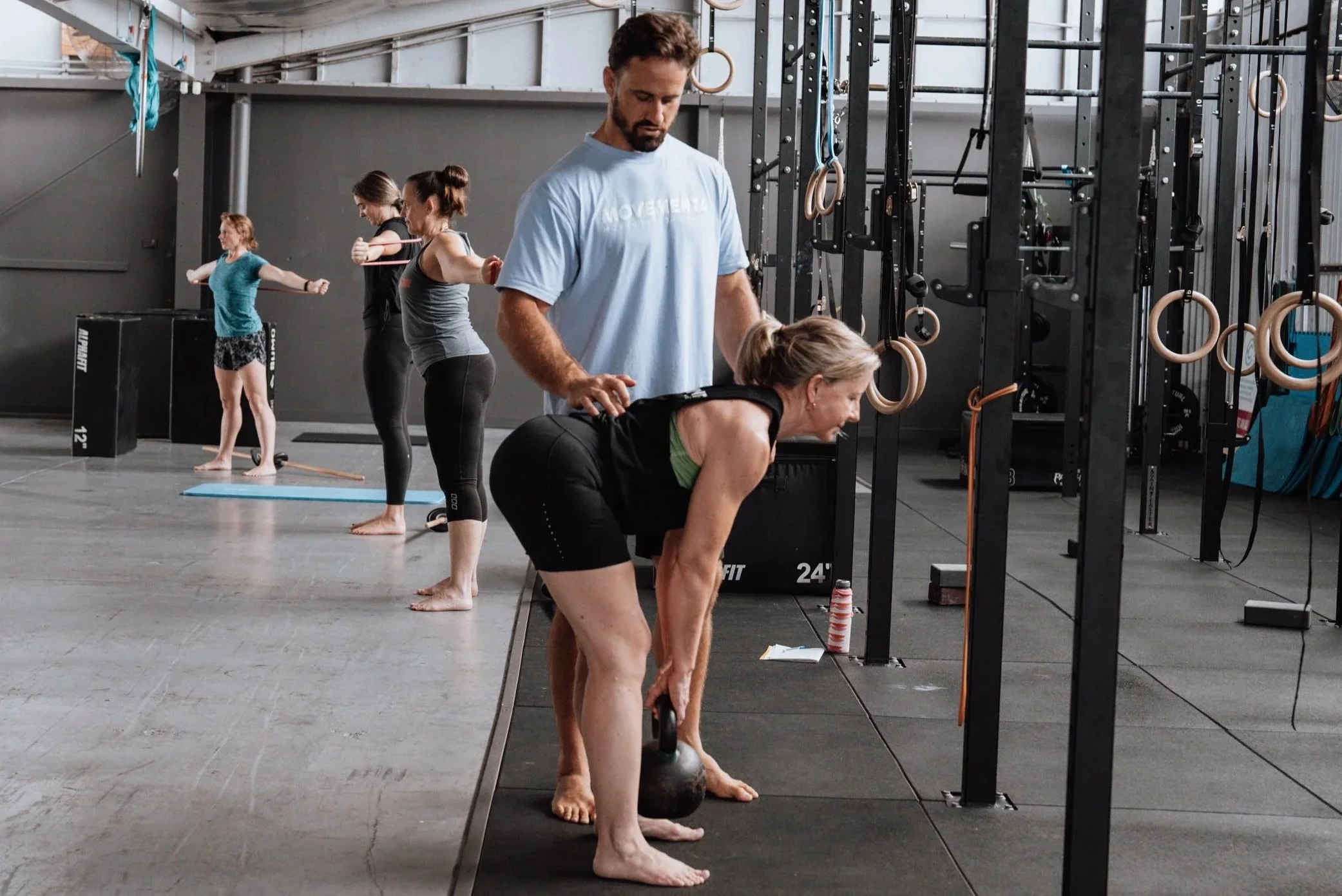
One of the most important lessons in supporting people with bone health concerns is that a diagnosis should not create unnecessary fear around movement. I see this fear play out with clients regularly. Women told, after a low-risk osteopenia diagnosis with no previous fracture, that they should limit certain movements indefinitely.
I certainly do not dismiss it lightly and there is real nuance here. For people with previous vertebral fractures or genuinely high fracture risk, certain movements may need to be modified. Individual guidance matters, especially for someone new to exercise or unsure what is safe for them.
But modifying a movement is very different from being told to never do it again. Becoming afraid to bend, lift or challenge ourselves leads to less movement, declining muscle strength and reduced confidence, which can ultimately increase risk rather than reduce it. Daily life still requires our spine to move. Picking up a grandchild, tying a shoe, reaching into the boot of the car.
A diagnosis should not become a reason to stop using the body. It should be an opportunity to learn how to use it more effectively.
Where Medical Treatment Fits
Lifestyle does not always provide the whole answer to reducing risks. For some people, particularly those at high or very high fracture risk, medical treatment plays an important role alongside strength training and nutrition.
Treatment decisions should be based on the individual’s complete history including previous fractures, current fracture risk, bone density, age, general health, and how someone has responded to earlier treatment. Hormone therapy can also play a meaningful role in reducing menopausal bone loss for some women, though it is not always a universal fix and depends on individual history and risk.
Clinical discussions at the 2024 Santa Fe Bone Symposium reinforced an important point, medical treatment is not a one-off fix. For some medications, stopping without an ongoing plan in place can allow bone density to fall rapidly, undoing much of what was gained. Whatever treatment path is chosen, the foundations, strength training, nutrition and ongoing monitoring, need to continue alongside it.
My Foundations
Strength training has become central to how I support bone health, but it is not the whole picture. Bone health is supported by the other foundations of health and longevity I write about so often, including:
· Progressive strength training – heavier, appropriately loaded work, not just gentle movement, gives bone a reason to adapt.
· Animal based protein – adequate intake to support both muscle and bone tissue, particularly important as we age.
· Calcium from real food – dairy, leafy greens, tinned fish with bones, and other whole-food sources.
· Vitamin D – supports calcium absorption, influenced by sun exposure, age, skin type and lifestyle.
· Sleep and recovery – the body needs time and resources to adapt to training.
· Hormonal health, stress, alcohol and smoking – all influence bone over time.
Healthy bones are supported by the same consistent foundations that underpin so much of our health.
What Changed for Me
My diagnosis of osteopenia became a turning point that facilitated a change to the way I trained, moving away from relying mainly on Pilates and general activity, and towards progressive strength work. I focused on building and maintaining muscle, paid much closer attention to my protein intake, adequate sunshine and recovery.
My follow-up DXA scan showed improvements in my bone density, which was great. This reflected a combination of progressively challenging my body, supporting my nutrition, addressing my hormonal health, and staying consistent over time.
I also gained a much clearer understanding of how I wanted to age, and what I needed to prioritise if I wanted to keep learning, training, working and participating fully in life.
That experience now shapes the way I coach. I want the people I train with to understand that strength training is not just about today's workout. It is an investment in the body they will rely on in ten, twenty or thirty years.
Strength for Life
Strong bones matter, but they are not the final goal. They are part of what allows us to keep lifting grandchildren, travelling, learning new skills, walking confidently, maintaining our independence, and doing the things that bring purpose and joy to our lives.
It is never too early to invest in our bones and our strength, and a diagnosis does not mean it is too late. For me, osteopenia became the beginning of a deeper understanding of strength, confidence and ageing well.
Choose strength. Choose informed movement, not fear. Choose to build a body that can carry you fully into the decades ahead.